
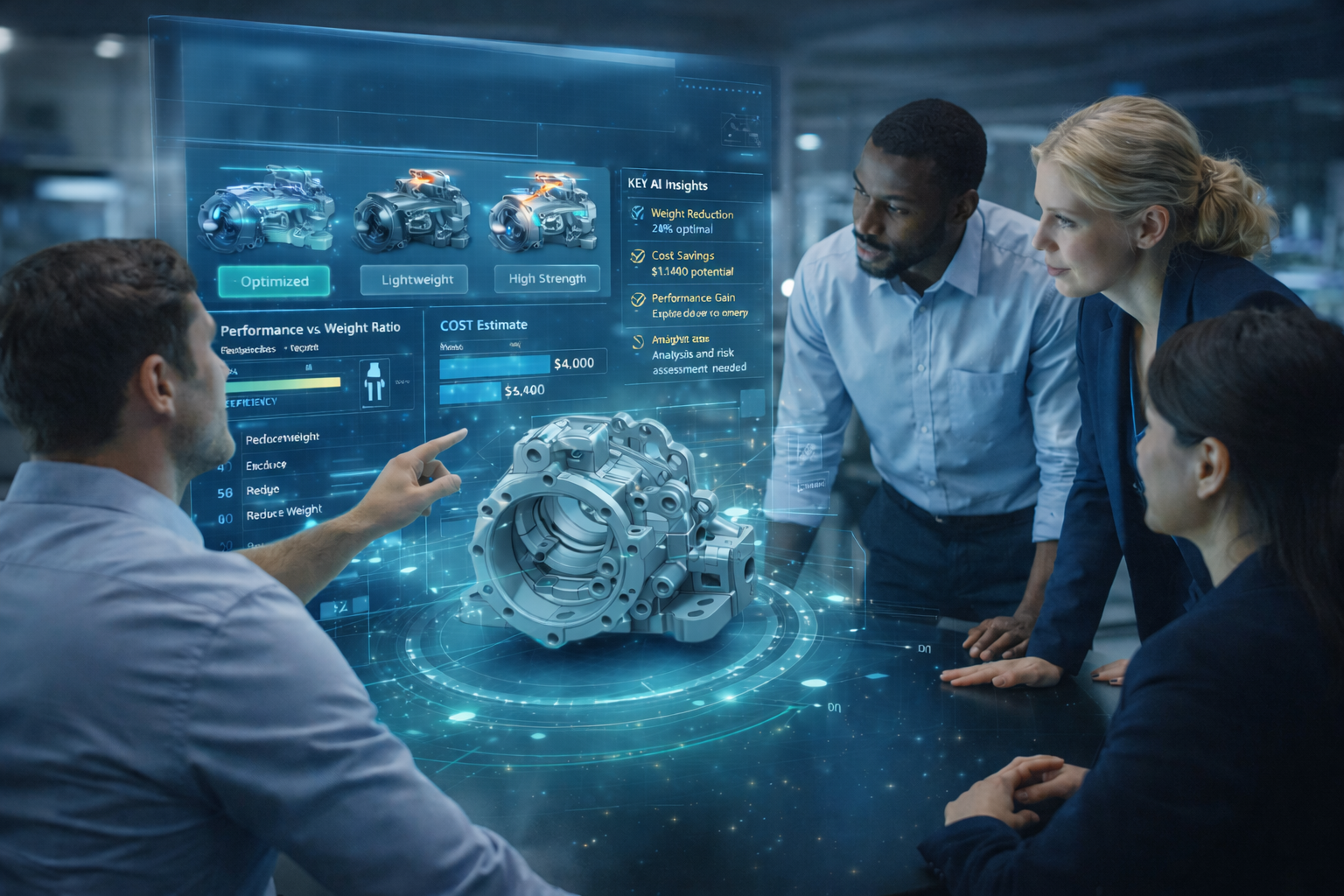
How is agentic AI changing engineering workflows?
Artificial intelligence and automation have long been discussed together, often with AI portrayed as an autonomous assistant capable of handling complex tasks with little human involvement. In reality, most AI tools used in engineering today remain reactive. They respond to prompts, execute narrow tasks, and rely heavily on users to guide each step. That dynamic is starting to change.
With the emergence of agentic AI and continued advances in large language models, the industry is moving closer to a more autonomous form of artificial intelligence, one that can plan, reason, and act toward defined goals. This shift has significant implications for how products are designed, validated, manufactured, and supported.
What is agentic AI?
Traditional AI tools require users to break work into individual steps. Each action is explicitly requested, executed, and reviewed before moving to the next step. Agentic AI builds on large language models but adds a decision-making framework around them.
An AI agent can understand an objective, decompose it into tasks, determine which tools and data to use, execute actions autonomously, and evaluate results along the way. Instead of simply answering questions, agentic AI works toward outcomes.
For engineering teams, this represents a fundamental shift. Rather than telling software how to perform every step, engineers can define what they want to accomplish and supervise the result.
From tools to teammates.
The most immediate benefit of agentic AI is efficiency. Engineering cycles shorten, repetitive tasks disappear, and tools become easier to use. However, the more strategic value lies in how agentic AI addresses one of the most persistent problems in product development, engineering silos.
Modern products require collaboration across mechanical, electrical, electronics, software, simulation, manufacturing, and supply chain teams. Each discipline brings deep expertise, but few individuals understand how decisions propagate across the entire lifecycle.
This lack of visibility drives late changes, rework, missed requirements, and cost overruns. Agentic AI helps close these gaps.
Breaking down engineering silos with agentic AI.
By connecting AI agents across the product lifecycle, teams can ask complex, cross domain questions in natural language and receive context aware answers. Examples include:
- What happens to manufacturing cost if this tolerance changes.
- Which suppliers are affected by this geometry update.
How does this design change impact tooling, inspection, and lead times?
Multiple agents collaborate behind the scenes, each accessing authoritative product data, manufacturing context, and simulation insight. The result is faster, better-informed decision making without endless meetings or manual data hunting.
In effect, agentic AI creates always available domain expertise that supports engineers, manufacturing teams, and even non-technical stakeholders.
Why Siemens is positioned to deliver agentic AI at scale.
Agentic AI is only as good as the data it can access. Without trusted, connected product information, AI becomes speculative and risky. Siemens Digital Industries Software provides a strong foundation through its integrated portfolio.
- NX delivers design and manufacturing intelligence.
- Simcenter delivers physics based validation and performance insight.
- Teamcenter delivers lifecycle governance and the system of record.
Together, these solutions form a connected digital thread. Agentic AI built on top of this environment delivers controlled product structures, versioned data, manufacturing context, and validated simulation results. This is what enables AI driven decisions that engineers can trust.
Quantifying ROI from agentic AI.
Agentic AI does not replace engineers. It removes friction from the engineering process and shifts effort toward higher value work. The ROI shows up in several measurable areas.
Faster engineering cycles.
Automating repetitive tasks and accelerating cross domain analysis reduces design iteration time and engineering change turnaround. Many organizations can expect a 15 to 30 percent reduction in engineering cycle time without increasing headcount.
Fewer late-stage changes.
The cost of change increases dramatically as products move downstream. Identifying impacts earlier reduces tooling rework, supplier disruption, and production delays. Even a small reduction in late changes delivers outsized financial returns.
Better engineering utilization.
Highly skilled engineers spend too much time searching for information, translating data between systems, and answering repetitive questions. Agentic AI absorbs this overhead, allowing teams to focus on innovation and problem solving instead of administration.
The shift in the engineer’s role.
As agentic AI matures, engineers move from task execution to orchestration. They define objectives, validate outcomes, and apply judgment where it matters most. AI handles the mechanics, while humans remain accountable for decisions. This is not about reducing expertise. It is about amplifying it.
The bottom line.
Agentic AI represents the next step in digital engineering. When combined with a connected digital thread, governed product data, and physics based validation, it becomes a force multiplier for engineering and manufacturing organizations.
For companies already investing in Siemens Digital Industries Software, agentic AI unlocks additional value from existing data while reducing friction across disciplines and accelerating decision making. Successful organizations will not be those that experiment with AI in isolation, but those that deploy it where real engineering decisions are made.