
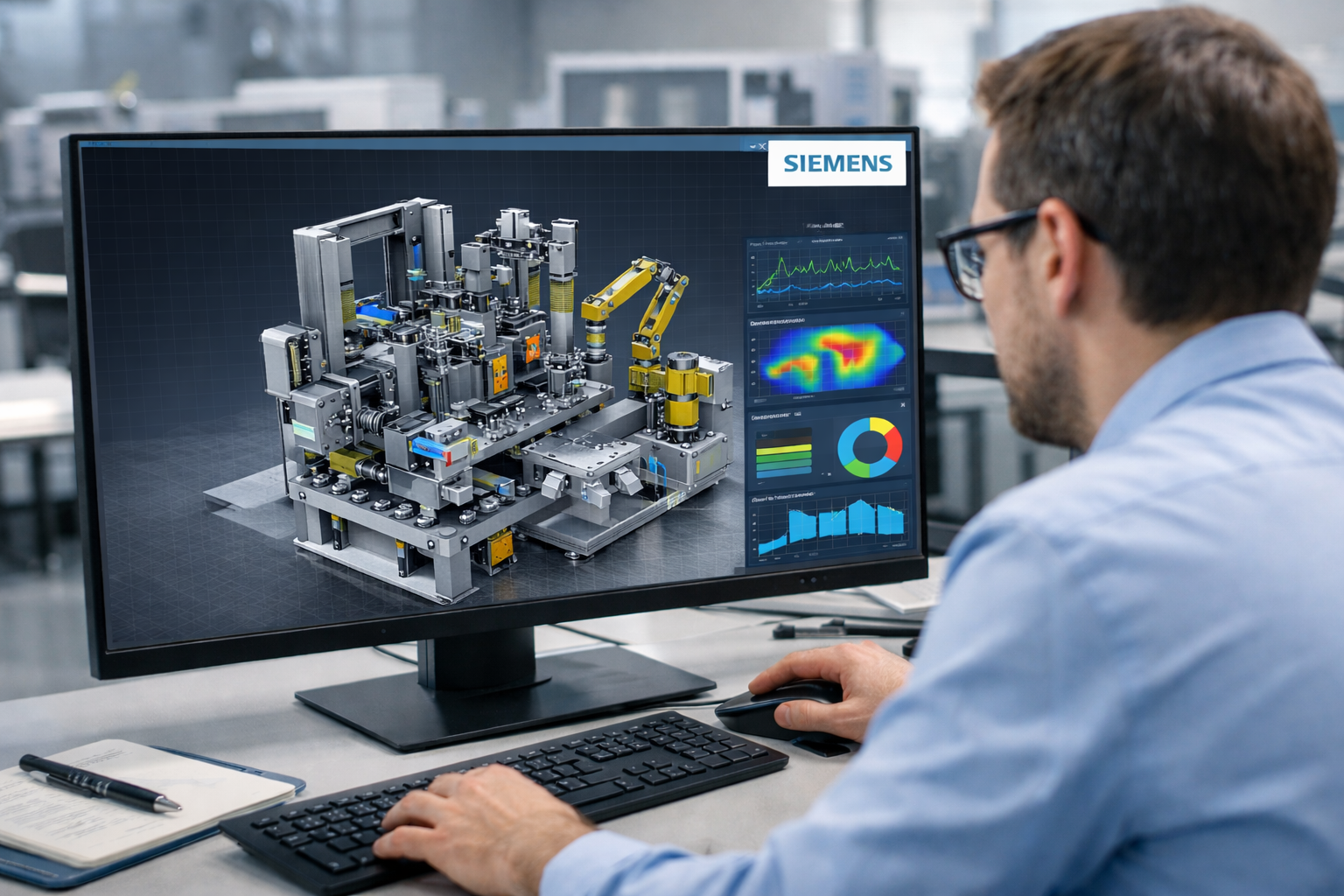
Why PLM has become a strategic requirement for machine builders.
The relationship between engineering speed, cost control, and product quality is no longer linear. As customization increases, unmanaged complexity becomes a direct threat to profitability.
Spreadsheets, disconnected CAD vaults, and manual handoffs force teams into sequential execution and late-stage rework. PLM breaks this pattern by establishing a single source of truth that connects requirements, design, manufacturing, and service across the lifecycle.
Siemens PLM for machine builders enables requirements-driven delivery, connected engineering, intelligent configuration, and lifecycle traceability, all on a shared digital backbone.
Benefit 1: Faster time-to-market through parallel execution.
Traditional NPDI follows a linear path that creates bottlenecks and delays. PLM enables parallel execution by allowing engineering, manufacturing, procurement, and service teams to work simultaneously from the same authoritative data.
Business Impact:
- Earlier risk visibility through real-time project dashboards.
- Fewer late-stage changes due to requirements traceability.
- Faster delivery without sacrificing quality.
This is not incremental acceleration, it is structural time compression.
Benefit 2: Cross-domain collaboration and transparency.
Machine builders operate across mechanical, electrical, controls, and software domains. When these disciplines work in silos, misalignment is inevitable. PLM creates a single collaboration environment where all stakeholders access current data, understand change impacts, and contribute earlier.
Business Impact:
- Reduced duplicated work.
- Fewer downstream surprises.
- Better decisions made earlier, when they are cheaper.
Benefit 3: Optimized product configuration and BOM management.
ETO and CTO environments amplify configuration risk. Without PLM, engineers manually validate orders and recreate similar BOMs repeatedly. PLM introduces rules-based configuration and modular product structures, enabling reuse without sacrificing flexibility.
Business Impact:
Raw material shortages, delivery delays, quality issues, and poor traceability can bring production lines to a halt. Without integrated material management and real-time coordination, manufacturers struggle to align supply availability with production demand.
Product variant complexity and changeovers:
- Engineering hours per order drop significantly.
- Cost and delivery estimates become reliable.
- BOMs stay synchronized across PLM, ERP, and MES.
Benefit 4: Knowledge capture and design automation.
Critical engineering knowledge is often undocumented and easily lost. PLM embeds best practices directly into workflows through rules-based design and automation, ensuring consistency and scalability.
Business Impact:
- Less reinvention.
- Faster onboarding of new engineers.
- More engineering time spent on innovation, not cleanup.
Benefit 5: Closed-loop service intelligence and continuous improvement.
PLM extends beyond delivery, connecting as-designed, as-built, and as-maintained data. Service feedback flows directly back into engineering, enabling continuous improvement and new lifecycle revenue opportunities.
Business Impact:
- Faster service response.
- Reduced warranty exposure.
- Better next-generation designs.
Quantified Executive ROI.
For machine builders adopting modern PLM platforms, typical results within 12–24 months include:
Engineering Productivity:
- 20–40% reduction in engineering hours per order.
- 25–30% fewer late engineering changes.
Time to Market:
- 15–25% faster project delivery.
- Weeks shaved off delivery schedules.
Cost and Margin Protection:
- 10–20% reduction in non-recurring engineering costs.
- Fewer expediting, scrap, and rework events.
Lifecycle Value:
- Lower service and warranty costs.
- New revenue from upgrades and lifecycle services.
For mid-sized machine builders, this routinely translates into seven-figure annual impact.
How to begin implementing PLM.
True value comes from transforming how knowledge flows, not just digitizing files. Successful implementations:
- Start with requirements-driven project delivery.
- Enable parallel execution early.
- Standardize configuration and reuse.
- Close the loop between engineering and service.
Siemens PLM solutions embed decades of machine-builder best practices into a secure, scalable platform designed for blended ETO and CTO environments.