
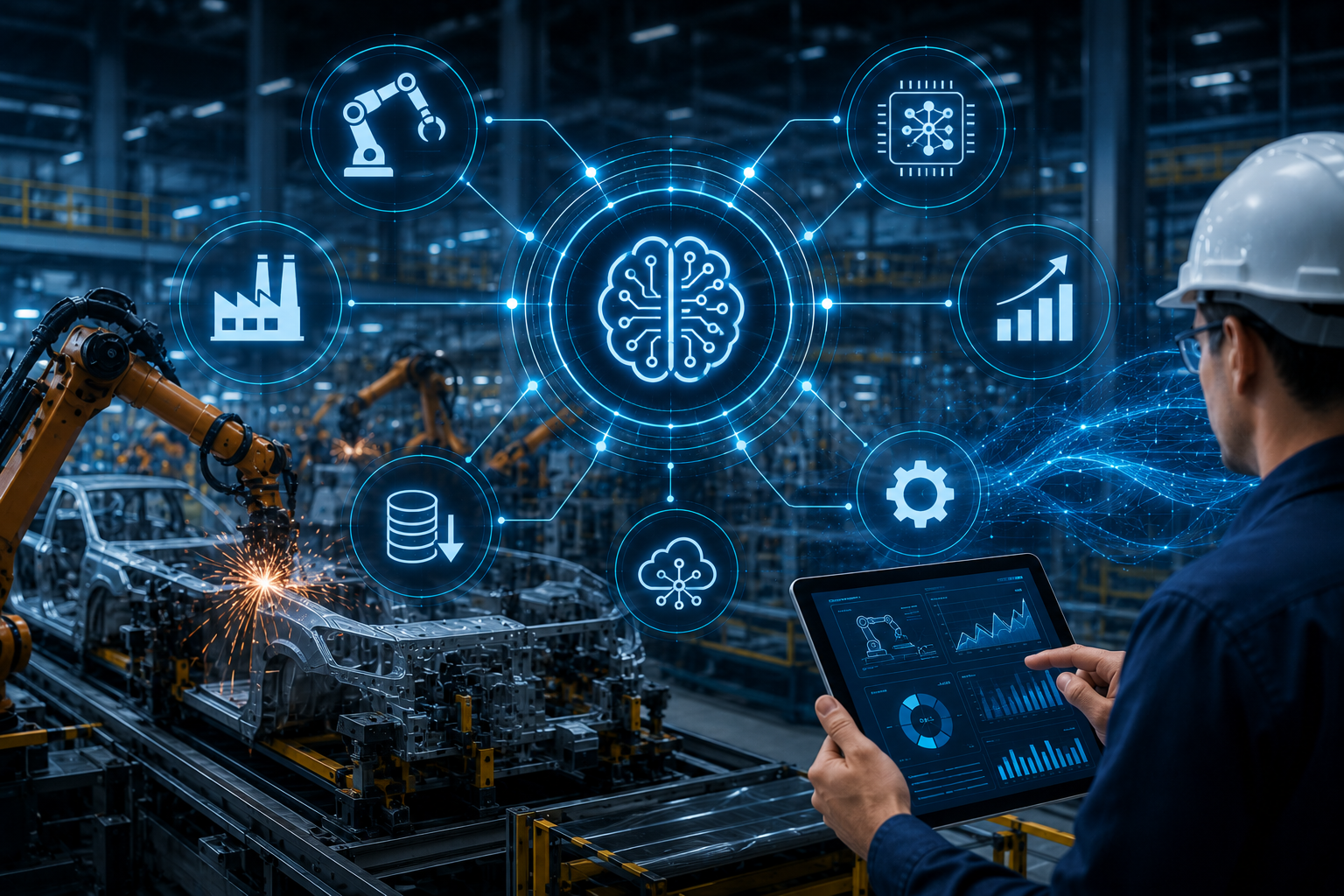
A day in the life of a modern shop floor.
Imagine a typical day for a shopfloor employee in automotive manufacturing. Production targets are rising. Staffing is tight. Complexity is increasing. At the same time, the reality on the ground looks like this:
- Data scattered across disconnected systems.
- Manual handovers between teams.
- Repeated simulation and planning cycles.
- Constant firefighting when something breaks.
Layer on top of that:
- Software-defined vehicles.
- Electrification.
- Sustainability mandates.
- Supply chain volatility.
It’s not just a workload problem. It’s a coordination problem.
From reactive to orchestrated.
This is where AI begins to change the equation. With digital thread-enabled workflows, Industrial Copilots, and agentic AI, the shopfloor moves from reactive to orchestrated. Instead of:
- Chasing data.
- Manually triggering processes.
- Responding after issues occur.
You get:
- Automated workflows across engineering, production, and logistics.
- Real-time orchestration of operations.
- Context-aware decision support.
The result is simple: Less firefighting. More flow.
Turning daily challenges into measurable value.
Modern manufacturing transformation isn’t about adding more tools, it’s about making systems work together intelligently.
New manufacturing technologies: Flexible, scalable production.
Modular production concepts and technology cells enable:
- Rapid reconfiguration of production lines.
- Scalability without major redesign.
- Adaptation to product and demand changes.
AI-enhanced systems and DC power technologies further improve:
- Energy efficiency.
- Sustainability performance.
- Operational consistency.
Critically, this transformation doesn’t require ripping out existing systems. By connecting brownfield and greenfield environments, manufacturers:
- Preserve past investments.
- Modernize incrementally.
- Avoid costly disruptions.
AI on the shop floor: From automation to autonomy.
AI is moving beyond basic automation into agentic decision-making. With Industrial Copilots and software-defined automation:
- PLC, SCADA, and HMI systems become unified.
- Operators get real-time, context-aware assistance.
- Workflows execute automatically across systems.
This leads to:
- Faster response to production changes.
- Reduced manual intervention.
- Improved quality consistency.
Data-driven production: Turning “dark data” into action.
Most manufacturers already have the data, they just can’t use it effectively. AI changes that. By orchestrating data across systems, manufacturers can
- Identify root causes faster.
- Predict issues before they occur.
- Optimize processes continuously.
With low-code AI tools and digital twins, shopfloor teams can:
- Run simulations without deep data science expertise.
- Test scenarios virtually.
- Make faster, better-informed decisions.
Quantified ROI: What next-generation manufacturing delivers.
This is where AI moves from concept to business case. Manufacturers implementing AI-driven shopfloor transformation are seeing:
Operational efficiency:
- 20–40% improvement in production throughput.
- Significant reduction in manual intervention.
- Faster planning and execution cycles.
Quality and cost:
- 15–30% reduction in rework and scrap.
- Lower warranty costs through early issue detection.
- More consistent production outcomes.
Downtime reduction:
- 10–25% improvement in equipment uptime.
- Predictive insights reduce unplanned stoppages.
Workforce productivity:
- 30–50% reduction in manual coordination tasks.
- More time for value-added work and innovation.
- Faster onboarding with AI-assisted workflows.
Time-to-value:
- Faster deployment through low-code and modular architectures.
- Incremental improvements without large-scale disruption.
Key values delivered.
AI-powered manufacturing transformation consistently drives:
- Flexibility & scalability through modular production.
- Minimal disruption via brownfield/greenfield integration.
- Higher efficiency & quality with agentic AI and copilots.
- More innovation capacity by automating repetitive work.
- Actionable insights that reduce rework and warranty costs.
- Empowered teams with accessible AI and digital tools.
- Secure, scalable data use through governed architectures.
A practical path forward.
For most manufacturers, the path isn’t a massive overhaul, it’s a series of smart steps:
- Start with high-impact use cases (quality, planning, maintenance).
- Connect key data sources across systems.
- Introduce AI-assisted workflows gradually.
- Scale what works across plants and programs.
This approach reduces risk while delivering immediate, measurable value.
The bottom line.
Next-generation manufacturing isn’t about replacing people with AI. It’s about:
- Removing friction.
- Connecting systems.
- Enabling faster, smarter decisions
The manufacturers pulling ahead are the ones turning their shopfloors into:
connected, intelligent, and continuously improving operations.
Start your AI manufacturing journey.