
The executive guide to smart manufacturing.
Artificial intelligence has become one of the biggest investment priorities in manufacturing. Companies everywhere are investing in Industrial AI, connected equipment, robotics, automation, and advanced analytics with the expectation of improving productivity, reducing downtime, and accelerating growth.
As teams grow and products become more complex, these small inefficiencies compound into costly delays that consume engineering time, slow product development, and shorten valuable runway.
Yet many manufacturers are asking the same question: where is the return on investment?
Industry research shows that while most manufacturers believe smart manufacturing will improve their competitiveness, relatively few have realized measurable financial returns from AI investments alone. The difference isn’t the technology. It’s how the technology is connected.
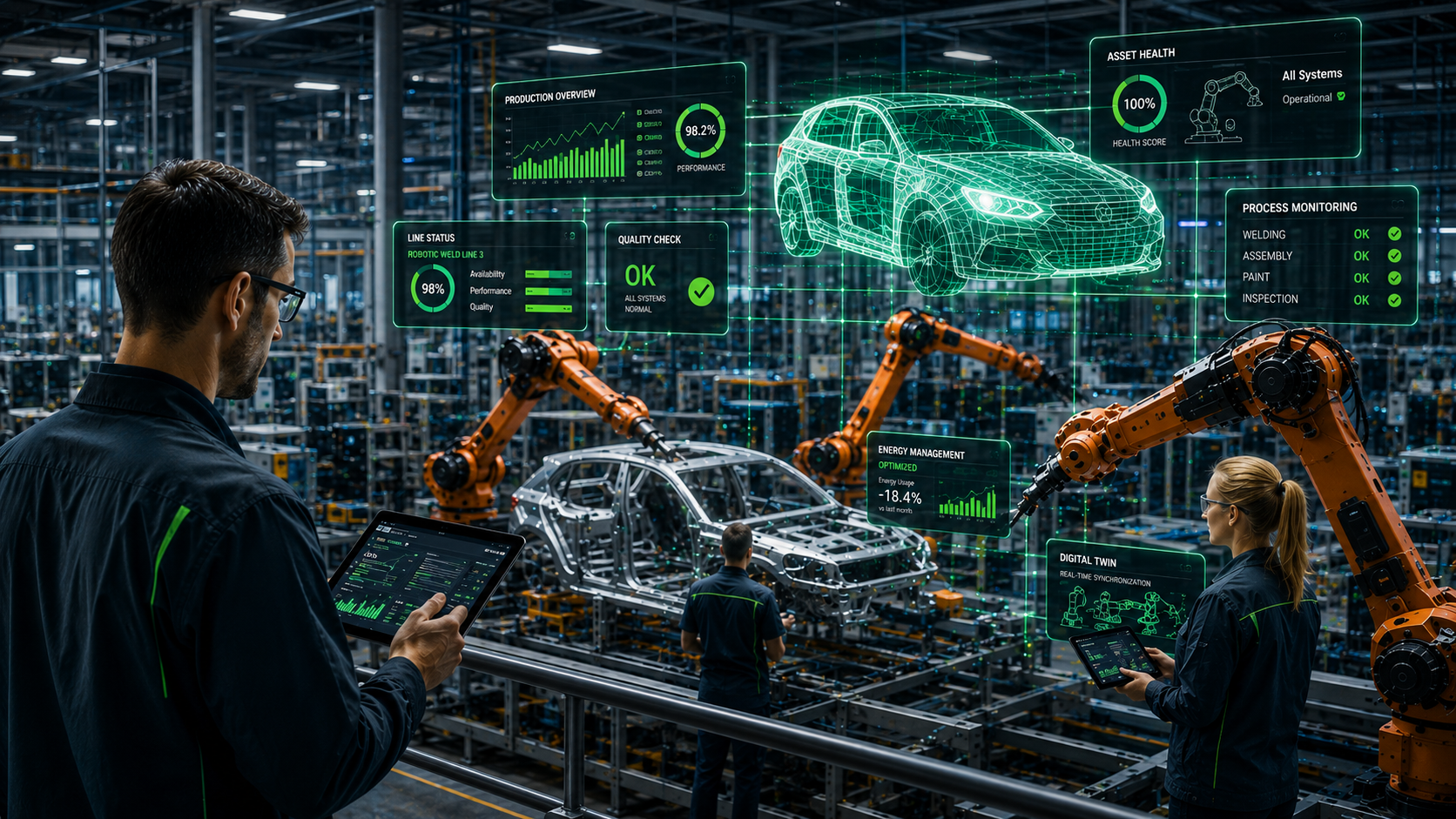
Manufacturers achieving the strongest results aren’t treating AI as another standalone application. They’re combining Industrial Internet of Things (IIoT), digital twins, and Industrial AI into one connected digital ecosystem that continuously learns, predicts, and improves operations.
With Siemens Digital Industries Software, manufacturers can connect engineering, production, and operational data into a single digital thread that transforms isolated technologies into measurable business value.
Why AI projects often stall.
Many AI initiatives begin with high expectations but quickly reach a plateau. The organization installs sensors. It collects massive amounts of machine data. Dashboards multiply. Yet production teams still spend their day reacting to problems instead of preventing them. The challenge isn’t data availability, it’s context.
Without understanding how products, equipment, production schedules, maintenance history, and engineering changes relate to one another, AI can identify anomalies but cannot recommend the best course of action with confidence. Successful manufacturers solve this by building three connected capabilities:
- Connected operational data.
- Virtual models that simulate factory performance.
- AI that continuously optimizes production.
Together, these create a manufacturing environment capable of learning and improving every day.
IIoT: building the data foundation.
Everything begins with connected data. Industrial Internet of Things (IIoT) technologies collect information from machines, PLCs, robots, sensors, quality systems, and production equipment throughout the factory.
This provides real-time visibility into:
- Machine health.
- Production performance.
- Energy consumption.
- Quality metrics.
- Equipment utilization.
- Production throughput.
Using Siemens industrial IoT platform tools, manufacturers can securely collect, contextualize, and analyze operational data across multiple facilities. Instead of isolated machine information, production teams gain enterprise-wide visibility into factory performance. But visibility alone doesn’t optimize manufacturing. It simply tells you what is happening.
Virtual twins: test before you invest.
Every manufacturing change carries risk. A production line modification. A robot integration. A layout redesign. A scheduling adjustment. Traditional manufacturing often discovers problems after implementation, when downtime, quality issues, or bottlenecks become expensive realities.
Digital twins fundamentally change that process. Using Tecnomatix, manufacturers can create a virtual representation of production systems, allowing engineers to model, simulate, and optimize manufacturing processes before changes reach the shop floor.
Instead of relying on trial and error, manufacturers can evaluate multiple production scenarios, identify constraints, and optimize workflows in a virtual environment. This enables organizations to:
- Validate production line changes.
- Optimize robot programming.
- Improve material flow.
- Balance production capacity.
- Reduce commissioning risk.
- Improve operator safety.
Every decision becomes data-driven before capital is committed.
Industrial AI: turning data into decisions.
Once operational data and digital twins work together, Industrial AI becomes significantly more valuable. Instead of simply reporting events, AI can interpret manufacturing context and recommend actions that improve performance. Industrial AI helps manufacturers:
- Predict equipment failures before downtime occurs.
- Detect quality deviations earlier.
- Optimize production scheduling.
- Balance manufacturing resources.
- Reduce energy consumption.
- Identify hidden production bottlenecks.
Unlike general-purpose AI tools, industrial AI is trained using engineering knowledge, manufacturing rules, and operational data. This creates recommendations manufacturers can trust because they’re grounded in real production environments. Rather than replacing engineers and operators, AI augments their expertise by eliminating repetitive analysis and surfacing opportunities that would otherwise remain hidden.
Bringing it all together.
The greatest return doesn’t come from implementing IIoT, virtual twins, or AI independently. It comes from integrating them. Siemens Digital Industries Software connects engineering, manufacturing, and operational data into a continuous digital thread that supports smarter decisions throughout the production lifecycle.
Solutions such as Teamcenter provide a single source of product and manufacturing data, ensuring engineering changes flow seamlessly into production. Meanwhile, Tecnomatix enables manufacturers to simulate and optimize production systems before physical implementation, dramatically reducing commissioning time and operational risk.
When these capabilities are combined with Industrial AI and connected IIoT data, manufacturers create an environment where every improvement continuously feeds the next. The result is a factory that becomes smarter with every production cycle.
Measurable business results.
Connected smart manufacturing delivers benefits across the entire organization. Manufacturers commonly achieve:
- Faster production planning and commissioning.
- Reduced engineering change delays.
- Lower unplanned downtime through predictive maintenance.
- Improved product quality.
- Better resource utilization.
- Increased production flexibility.
- Lower operational costs.
- Faster response to supply chain disruptions.
Perhaps most importantly, teams spend less energy coordinating work and more energy solving engineering challenges. That reduces risk while accelerating innovation.
Start small. Scale fast.
The most successful manufacturers don’t attempt enterprise-wide transformation overnight. Instead, they begin with one high-value use case. Examples include:
- Predictive maintenance.
- Production scheduling optimization.
- Virtual commissioning.
- Robotics simulation.
- Energy optimization.
Once measurable results are achieved, organizations expand the digital thread across additional production lines, facilities, and business units. This phased approach minimizes disruption while building organizational confidence.
The future factory is already here.
Manufacturing leaders no longer compete solely on automation. They compete on intelligence. Factories that combine connected IIoT data, virtual twins, and Industrial AI are making faster decisions, reducing operational risk, and continuously improving performance.
Those that continue treating these technologies as separate initiatives will struggle to achieve meaningful ROI. Smart manufacturing isn’t about adding more technology. It’s about connecting the technology you already have into one intelligent manufacturing ecosystem.
With Siemens Digital Industries Software, manufacturers can transform isolated data into actionable intelligence, optimize operations before problems occur, and build factories that continuously learn, adapt, and improve.
The future of manufacturing isn’t automated. It’s connected. Ready to turn your AI investment into measurable manufacturing results?
Discover how Teamcenter, Tecnomatix, and Siemens Industrial AI solutions can help you build a connected digital manufacturing ecosystem that delivers faster innovation, greater efficiency, and lasting competitive advantage.