
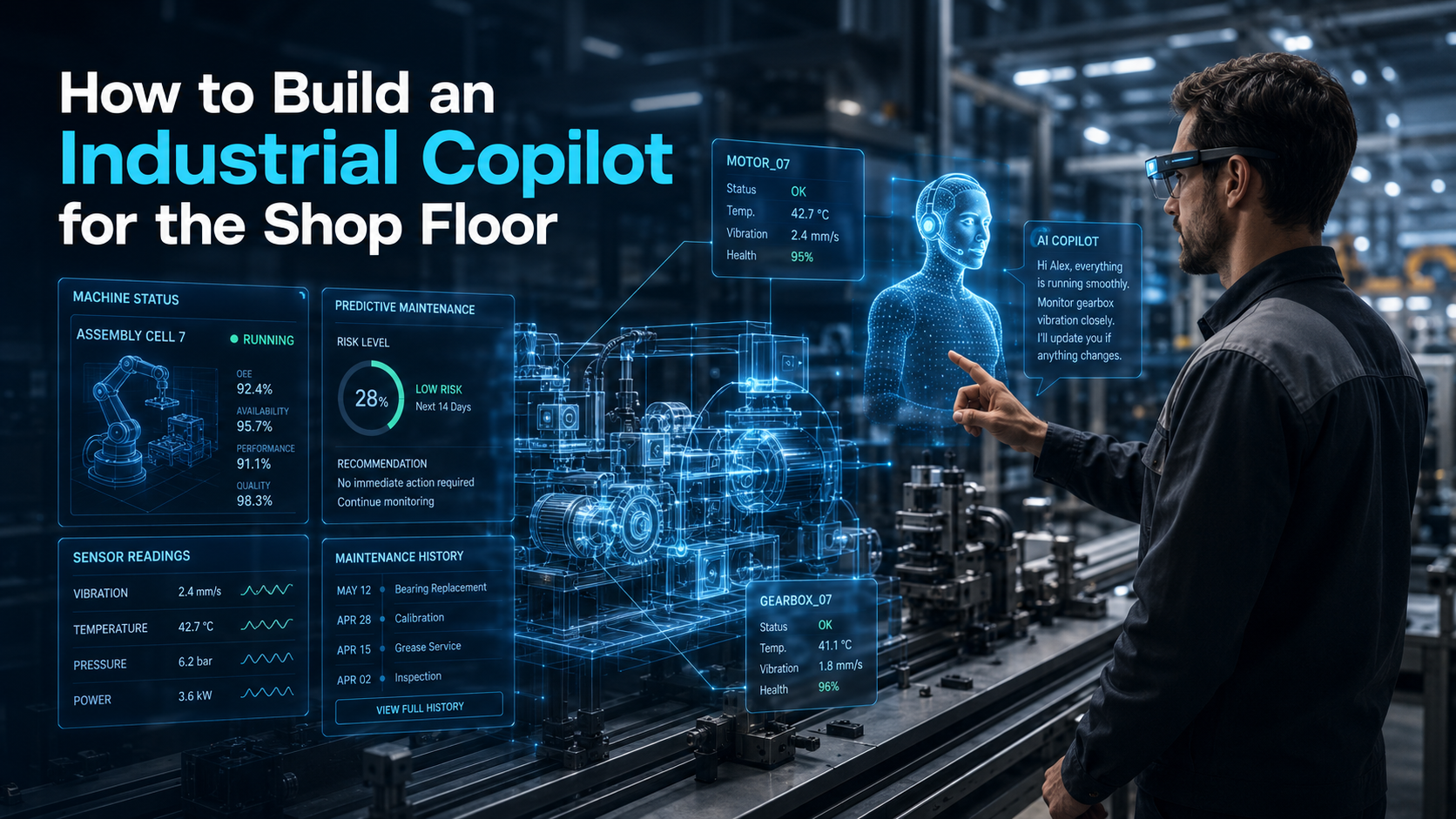
The digital twin is the brain behind every industrial copilot.
Why Industrial Copilots require Digital Twins, connected data, and contextual intelligence to transform manufacturing. Artificial intelligence is quickly becoming part of everyday manufacturing operations. But creating an Industrial Copilot that truly helps operators, technicians, and maintenance teams takes far more than connecting a chatbot to a knowledge base.
On the shop floor, context matters. An operator troubleshooting a production line doesn’t simply need documentation. They need to understand what machine is affected, what changed recently, whether similar failures have occurred before, and what impact a repair could have on production.
That’s why successful Industrial Copilots combine AI with Digital Twins and connected manufacturing data. Together, they create intelligent assistants that understand equipment, production processes, and operational context—helping employees make better decisions faster.
With Siemens Digital Industries Software, manufacturers can connect engineering data, operational information, and digital twins to create Industrial Copilots that improve productivity without replacing human expertise.
A manufacturing copilot is more than a chatbot.
Many organizations assume deploying AI is simply a matter of giving employees conversational access to technical documentation. While useful, documentation alone rarely solves manufacturing problems.
Consider a maintenance technician responding to an unexpected machine fault. Instead of searching through manuals or maintenance records, they want immediate answers:
- What caused this alarm?
- Has this failure happened before?
- Which component is most likely responsible?
- What repair procedure has worked previously?
- Will stopping this machine affect downstream production?
Answering these questions requires much more than stored documents. It requires context. Industrial Copilots must understand equipment status, maintenance history, engineering relationships, and operational priorities before they can provide meaningful recommendations.
User experience determines adoption.
The most intelligent AI assistant provides little value if employees don’t want to use it. Successful Industrial Copilots are designed around how people naturally work, not how software expects them to work. Operators should be able to ask questions naturally without navigating multiple applications or searching through complex documentation.
Emerging technologies such as wearable devices, tablets, and augmented reality are making this experience even more intuitive by delivering contextual information directly where work happens. The goal isn’t adding another application.
It’s reducing the effort required to solve problems. When accessing expert knowledge becomes faster than asking a coworker or searching manuals, adoption follows naturally.
Why the digital twin is the copilot’s brain.
Every effective Industrial Copilot needs a reliable source of truth. This is where the Digital Twin becomes indispensable.
A Digital Twin is far more than a 3D model. It is a continuously updated digital representation of equipment, production systems, engineering data, and operational history.
Using Teamcenter, manufacturers can connect product information, engineering changes, service history, and manufacturing data into a single digital thread. This enables an Industrial Copilot to understand:
- Current equipment configuration.
- Engineering revisions.
- Historical maintenance records.
- Product relationships.
- Operational performance.
- Production dependencies.
Instead of searching disconnected systems, the copilot accesses one connected source of contextual information. The result is faster, more accurate recommendations that align with real operating conditions.
Simulating “what if?” before taking action.
One of the most valuable capabilities of an Industrial Copilot is answering questions before changes are made. For example:
- What happens if we increase conveyor speed?
- Can this robot cell support a higher production rate?
- Will taking this machine offline create a bottleneck?
Rather than relying on assumptions, manufacturers can evaluate these scenarios inside a Digital Twin. With Tecnomatix, production teams can simulate manufacturing processes, validate production changes, and analyze operational impacts before implementing them on the factory floor.
The Industrial Copilot uses these simulation results to recommend safer, more informed decisions without interrupting production. Testing virtually dramatically reduces operational risk while improving confidence in every decision.
Connected manufacturing creates better AI.
Artificial intelligence performs best when it understands relationships, not just individual pieces of information. This requires connected manufacturing data.
When engineering, production, maintenance, and quality information remain isolated inside separate applications, AI recommendations become incomplete. By connecting these systems through a digital thread, Industrial Copilots gain the context necessary to support decisions across the manufacturing lifecycle.
Instead of answering isolated questions, the AI begins understanding the broader manufacturing environment. That shift transforms AI from an information assistant into a true operational advisor.
Human expertise remains essential.
Industrial Copilots are designed to augment people, not replace them. Experienced technicians bring practical knowledge that no AI model can fully replicate. Operators understand production nuances that don’t always appear in data. Engineers recognize design tradeoffs requiring human judgment.
Industrial Copilots remove repetitive information gathering, documentation searches, and routine troubleshooting so experts can focus on solving higher-value problems. The result is faster decision-making with greater consistency across shifts, facilities, and teams.
Building an industrial copilot starts with connected data.
Manufacturers don’t need to solve every problem on day one. The most successful deployments begin with focused use cases, such as:
- Maintenance troubleshooting.
- Operator assistance.
- Machine diagnostics.
- Production support.
- Equipment documentation.
- Knowledge transfer for new employees.
As organizations connect more engineering and operational data through platforms like Teamcenter and expand Digital Twin capabilities with Tecnomatix, Industrial Copilots become increasingly intelligent and valuable. Each successful deployment strengthens the digital foundation for broader AI adoption across manufacturing operations.
The future of manufacturing is collaborative intelligence.
Industrial Copilots represent the next evolution of smart manufacturing. When combined with Digital Twins, connected operational data, and engineering intelligence, they become trusted assistants capable of helping employees solve problems faster, reduce downtime, and improve production performance.
The future isn’t about replacing workers with AI. It’s about giving every worker immediate access to decades of engineering knowledge, operational expertise, and real-time manufacturing intelligence.
Manufacturers that invest in connected Digital Twins today will be the ones best positioned to realize the full value of Industrial AI tomorrow.
The future factory is already here.
Ready to explore how Industrial Copilots can improve productivity across your manufacturing operations?
Discover how Teamcenter and Tecnomatix help manufacturers build connected Digital Twins that power the next generation of AI-assisted manufacturing. We can help.