
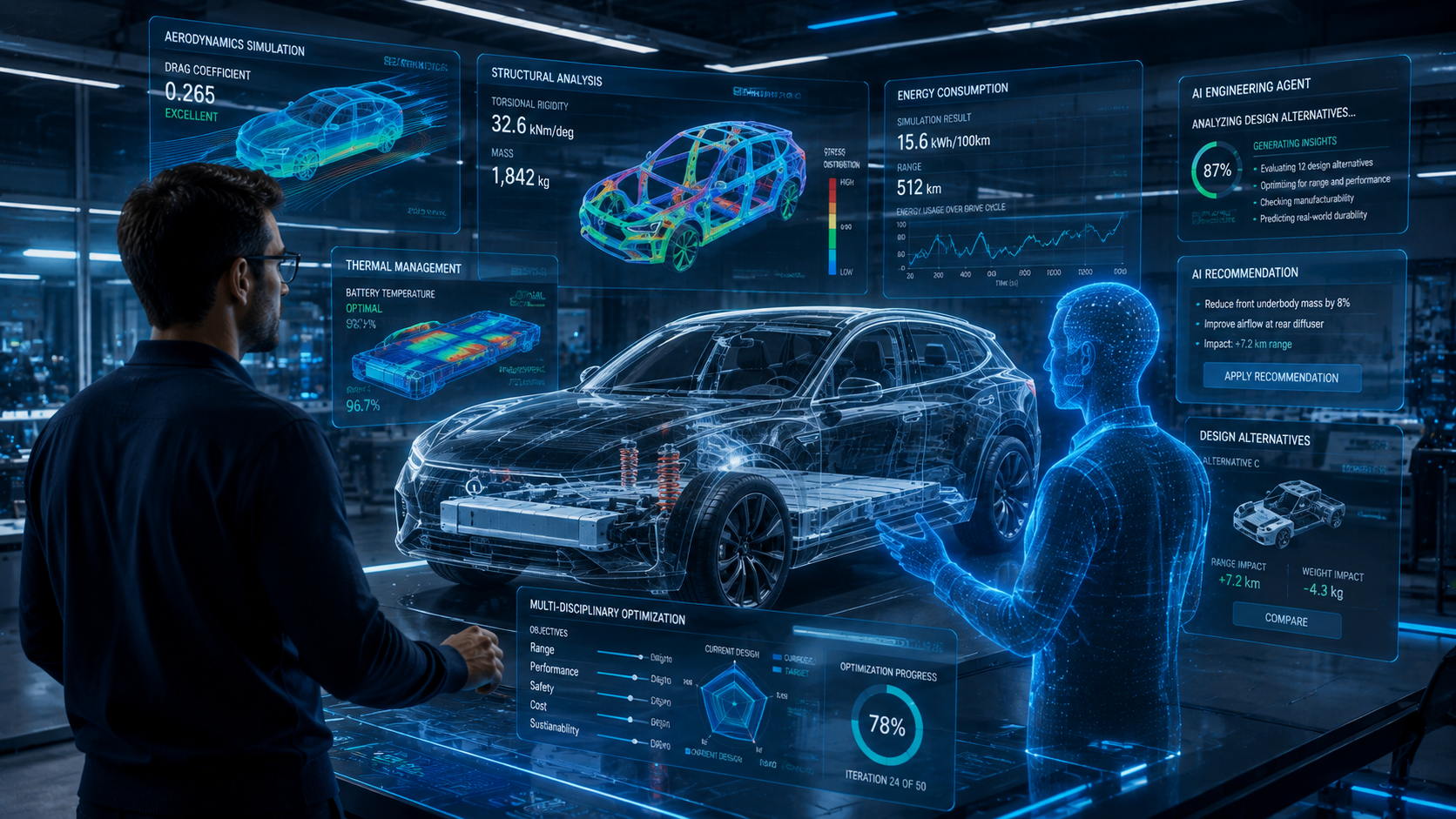
How agentic AI is transforming engineering.
For decades, engineering software has become faster, smarter, and more powerful. Yet one challenge has barely changed. Engineering expertise remains scarce. Across manufacturing, aerospace, automotive, electronics, and industrial equipment, there are millions of engineers who need simulation, optimization, and systems analysis every day, but only a fraction possess the specialized knowledge required to perform advanced engineering analysis.
The result?
Projects wait. Simulation queues grow longer. Design decisions slow down. Innovation suffers. Agentic AI is changing that equation.
Rather than asking engineers to become simulation experts, Agentic AI brings engineering expertise directly to them through intelligent AI agents that collaborate, reason, and automate engineering workflows.
Combined with Teamcenter and Simcenter, Agentic AI has the potential to fundamentally reshape how products are designed, validated, and optimized.
Engineering’s hidden productivity bottleneck.
Imagine an engineer designing a new electric vehicle battery enclosure. Before releasing the design, they need to answer a simple question:
Will this design survive thermal and structural loading?
Today, answering that question often requires handing the design to simulation specialists who configure models, prepare geometry, select physics, generate meshes, execute analyses, and interpret results.
Even in highly efficient organizations, that process may take days. If the design fails, the cycle starts again. The limitation isn’t software performance. It’s access to engineering expertise. As product complexity continues to grow, engineering organizations simply cannot hire enough specialists to keep pace with demand.
From engineering software to engineering agents.
Traditional engineering software requires users to understand the tools. Agentic AI reverses that relationship. Instead of asking engineers to master increasingly sophisticated software, intelligent agents understand engineering goals and determine how to achieve them. An engineer might simply ask:
“Evaluate this battery enclosure for thermal performance under peak operating conditions.”
Behind the scenes, specialized AI agents coordinate the entire workflow.
They retrieve engineering data.
Configure simulations.
Select appropriate models.
Run analyses.
Interpret results.
Generate reports.
The engineer remains responsible for final decisions while AI handles the repetitive technical execution. This represents a significant evolution from automation toward intelligent engineering collaboration.
Specialized AI agents work better than general AI.
Engineering requires accuracy, traceability, and domain expertise. That’s why the future isn’t one large AI model trying to do everything. Instead, specialized engineering agents perform narrowly defined tasks exceptionally well. For example:
- A PLM agent retrieves product data from Teamcenter.
- A simulation agent configures Simcenter analyses.
- A materials agent identifies approved engineering specifications.
- A reporting agent summarizes engineering findings.
- A workflow agent coordinates activities between systems.
Each agent contributes domain-specific expertise while working together as part of a coordinated engineering workflow. This modular approach improves reliability while reducing the risk of inaccurate recommendations.
Digital threads give AI the context it needs.
Engineering decisions depend on context. A simulation result has little value without understanding:
- Product configuration.
- Material specifications.
- Engineering revisions.
- Design intent.
- Previous analyses.
- Manufacturing constraints.
This is where Teamcenter becomes essential.
As the digital thread connecting product information throughout the lifecycle, Teamcenter provides AI agents with the engineering knowledge necessary to make informed decisions. Instead of searching disconnected databases, AI agents access a complete, connected view of the product. This dramatically improves both speed and confidence in engineering recommendations.
Simulation becomes accessible to more engineers.
Historically, advanced simulation has been limited to specialists. Agentic AI changes that. With Simcenter, engineering agents can automatically configure many routine simulation tasks using established engineering best practices.
This allows product designers, systems engineers, and multidisciplinary teams to evaluate designs earlier in development without waiting for dedicated simulation resources. Simulation doesn’t become less sophisticated. It becomes more accessible.
Engineering specialists continue focusing on the most complex challenges while AI handles routine analyses that previously consumed valuable time.
What agentic engineering looks like.
Imagine an engineering change request arrives for an electric vehicle battery pack experiencing unexpected thermal behavior. Instead of coordinating multiple departments manually, AI agents work together to:
- Retrieve the latest design from Teamcenter.
- Identify affected components.
- Configure thermal simulations in Simcenter.
- Execute validation studies.
- Compare results against previous designs.
- Generate engineering reports.
- Notify stakeholders of potential risks.
Throughout the process, engineers review recommendations, approve decisions, and intervene only when expert judgment is required. The result is dramatically shorter engineering cycles with greater consistency across projects.
AI doesn’t replace engineers, it amplifies them.
One of the biggest misconceptions surrounding AI is that it replaces engineering expertise. The opposite is true. Agentic AI allows experienced engineers to apply their knowledge across far more projects than previously possible. Senior engineers define best practices. AI agents execute routine workflows consistently.
Junior engineers gain access to institutional knowledge that previously existed only through mentorship or tribal experience. This democratization of engineering expertise helps organizations address one of manufacturing’s most persistent challenges: the growing shortage of experienced engineering talent.
The future engineering organization.
As Agentic AI becomes more common, engineering organizations will evolve. New roles are already beginning to emerge. Engineering experts will increasingly become:
- AI workflow architects.
- Engineering knowledge curators.
- Digital process designers.
- Simulation governance leaders.
Meanwhile, more engineers across the organization will gain access to sophisticated simulation and analysis capabilities that were previously reserved for specialists.
Engineering becomes faster. Knowledge becomes more scalable. Innovation accelerates.
Building the future one workflow at a time.
Agentic AI won’t transform engineering overnight. Most organizations will begin with focused use cases such as:
- Automated simulation setup.
- Engineering knowledge retrieval.
- Design validation.
- Requirements traceability.
- Engineering change analysis.
- Automated reporting.
As confidence grows, organizations expand these intelligent workflows across product development. The greatest value comes from connecting engineering data, simulation, and AI, not replacing existing systems. Platforms like Teamcenter and Simcenter already provide the connected engineering foundation needed for this evolution.
The future engineer won’t work alone.
The next generation of engineering won’t be defined by better software interfaces. It will be defined by intelligent collaboration between engineers and AI. Agentic AI allows engineering teams to move beyond operating software toward directing intelligent workflows.
Routine work becomes automated. Engineering expertise becomes scalable. Innovation accelerates. Your next engineering colleague won’t replace your engineers. It will help every engineer accomplish far more than they ever could alone.
Ready to explore the future of AI-powered engineering?