
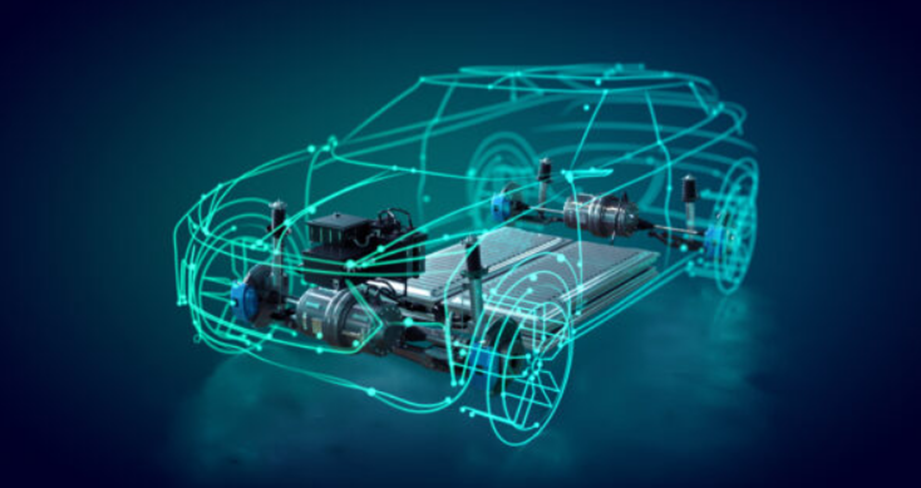
The growing pressure on automotive engineering.
Artificial intelligence is rapidly moving from hype to practical application across industries, but in automotive engineering, its real value is just starting to take shape.
Modern vehicles are no longer purely mechanical products. Electrification, software-defined architectures, advanced electronics, and thermal systems have transformed them into complex, multi-physics systems. That complexity is putting enormous strain on traditional simulation processes. Engineering teams are now expected to:
- Process significantly larger datasets.
- Simulate more scenarios across disciplines.
- Deliver results faster with fewer physical prototypes.
The result? Bottlenecks in simulation workflows, and slower innovation cycles.
Why simulation remains mission-critical.
Simulation has long been the backbone of automotive innovation. It allows engineers to:
- Validate designs before physical builds.
- Reduce costly prototypes.
- Identify performance issues early.
- Accelerate time-to-market.
But today’s simulations, crash, aerodynamics, thermal, battery systems, are far more demanding than they were even a decade ago. The problem isn’t simulation itself. It’s scale and complexity.
Where AI changes the game.
AI doesn’t replace simulation, it amplifies it. Its real strength lies in pattern recognition and data processing at scale. That’s exactly what modern simulation environments need. What AI does best in simulation workflows:
- Intelligent data reduction: AI filters massive simulation outputs and highlights what actually matters, saving engineers from days of manual analysis.
- Pattern recognition at scale: From crash simulations to thermal behavior, AI clusters results into meaningful patterns engineers can act on quickly.
- Faster design space exploration: AI models trained on historical simulation data can guide engineers toward optimal designs faster.
- Faster design space exploration: AI models trained on historical simulation data can guide engineers toward optimal designs faster.
- Workflow acceleration: Routine tasks, model setup, result sorting, comparison, can be automated, removing friction from the process.
From simulation tool to engineering copilot.
The next evolution is already underway: AI-powered engineering copilots. These aren’t replacing engineers, they’re removing the grunt work. In practice, this means:
- Suggesting simulation setups.
- Identifying anomalies automatically.
- Recommending design improvements.
- Assisting new engineers with onboarding and best practices.
Over time, these copilots evolve into agentic workflows, where engineers define goals and AI executes structured tasks, like modifying a model and rerunning simulations.
Quantified ROI: what AI-powered simulation actually delivers.
Let’s cut through the buzzwords, this is where it pays off. Manufacturers implementing AI-enhanced simulation are seeing:
Engineering productivity:
- 30–60% reduction in simulation analysis time.
- Up to 80% faster insight generation for specific workflows.
- Significant reduction in manual data interrogation.
Development speed:
- 20–40% shorter design cycles.
- Faster iteration across complex design spaces.
- Earlier validation reduces downstream delays.
Cost reduction:
- 15–30% fewer physical prototypes.
- Lower testing and validation costs.
- Reduced rework from late-stage issues.
Quality and performance:
- Improved first-time-right designs.
- Better optimization across multi-physics systems.
- Reduced risk of design flaws reaching production.
Workforce impact:
- Faster onboarding of new engineers.
- Reduced dependency on tribal knowledge.
- More time spent on innovation vs. administration.
Why now, not later.
AI in automotive simulation is still early, but that’s exactly why it matters. Companies that start now:
- Train AI on their proprietary data.
- Build internal capabilities early.
- Establish scalable workflows.
- Gain compounding advantages over time.
Waiting for “perfect AI” means falling behind teams already learning from real-world data.
The bottom line.
AI isn’t replacing simulation, it’s making it scalable. As vehicles become more complex, simulation alone isn’t enough. And AI alone isn’t enough either. The combination of AI + simulation is what unlocks speed, insight, and competitive advantage.
The companies that win won’t be the ones with the most tools.
They’ll be the ones that connect data, simulation, and AI into a unified engineering workflow.
Start your AI-driven simulation journey.