
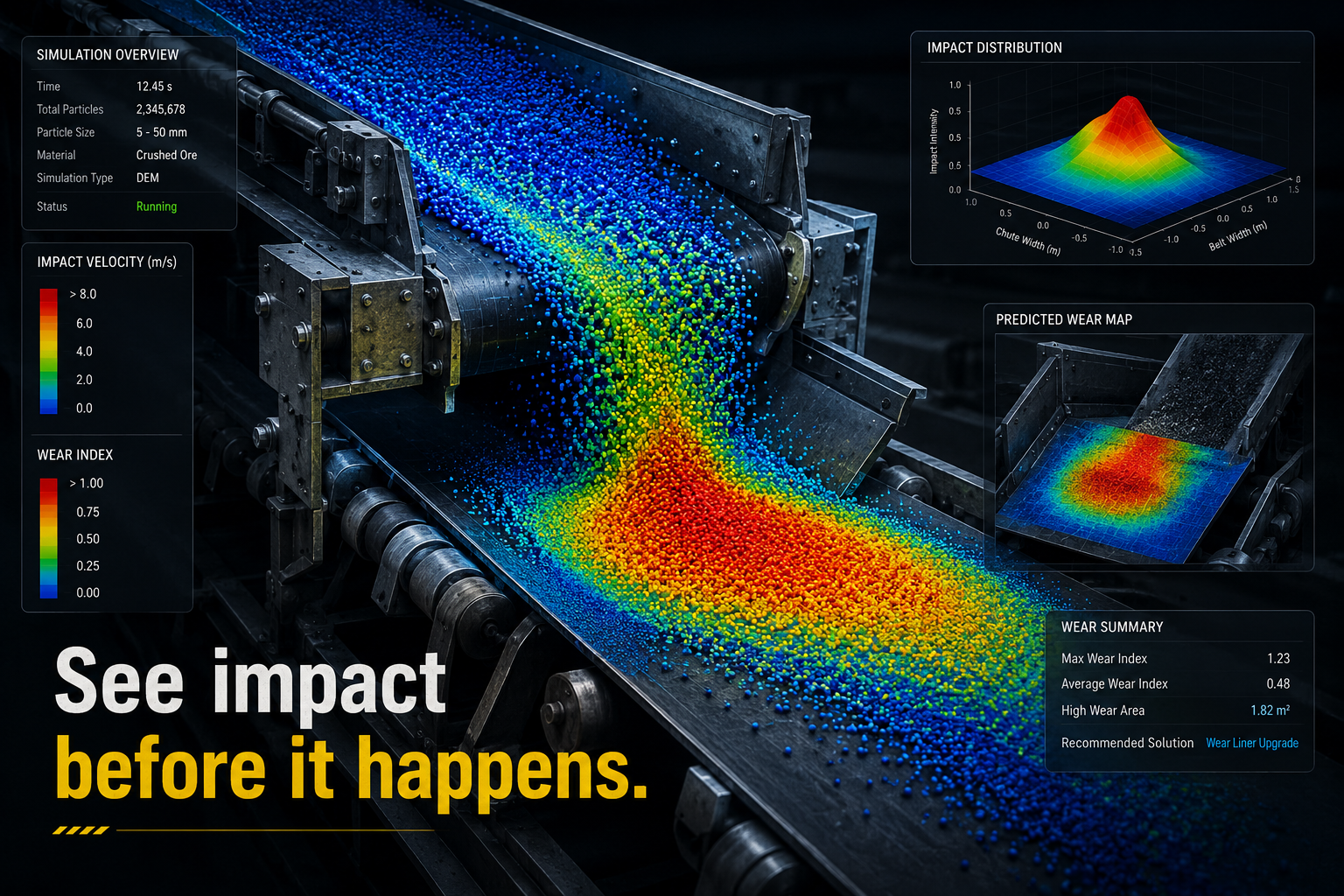
Prevent costly equipment damage and downtime in bulk material handling.
Bulk material handling looks simple from the outside, move material from point A to point B. In reality, it’s one of the most failure-prone and expensive areas of industrial production. Conveyors are constantly exposed to:
- High-impact loading zones.
- Continuous abrasive friction.
- Particle-driven surface wear.
- Unexpected mechanical failures.
And when something breaks, production doesn’t slow down, it stops. The good news: most of these failures are predictable and preventable at the design stage.
The hidden cost of poor conveyor design.
Bulk materials are often harder than the surfaces moving them. That mismatch creates a slow but relentless degradation cycle. What actually happens:
- Impact zones deform structural components.
- Friction erodes protective surfaces.
- Micro-wear accumulates into system failure.
- Maintenance becomes reactive instead of planned.
The real cost isn’t just repair, it’s downtime. For most manufacturing operations, a single conveyor failure can halt an entire production line. That’s where engineering simulation changes the equation.
Design failure starts before production begins.
Most conveyor failures are not manufacturing defects. They are design assumptions that were never validated. Common weak points include:
- Transfer points with uncontrolled impact.
- Elbows and bends in pneumatic systems.
- Poor material flow distribution.
- Underestimated abrasion zones.
Once physical systems are built, correcting these issues is expensive and disruptive. The smarter approach is simulation-driven validation before anything is built.
DEM modeling: seeing particle behavior before it becomes damage.
Discrete Element Method (DEM) modeling changes how engineers design bulk handling systems. Instead of treating material as a uniform flow, DEM simulates individual particle behavior. That means engineers can:
- Predict exact impact zones.
- Model wear patterns over time.
- Simulate friction under real operating conditions.
- Optimize geometry before fabrication.
Within Siemens Simcenter, DEM-based analysis allows manufacturers to virtually test conveyor systems under realistic load conditions before committing to physical builds. The result is fewer surprises, and far fewer failures.
Engineering solutions that actually work in the field.
Once failure zones are understood, engineers can design targeted mitigation strategies.
Ceramic-Composite Materials:
Used in high-impact areas where standard metals fail.
- High hardness.
- Improved thermal resistance.
- Reduced wear rate in abrasive environments.
Rock Boxes and Surge Pockets:
Instead of forcing material directly onto surfaces, rock boxes:
- Absorb initial impact energy.
- Encourage particle-to-particle collision.
- Reduce direct liner wear.
- Stabilize flow into downstream systems.
Impact Rollers:
Installed at transfer zones where material velocity is highest. Benefits include:
- Reduced belt deformation.
- Lower maintenance frequency.
- Improved load distribution.
- Extended conveyor lifespan.
Abrasion-Resistant Coatings and Liners:
The final protective layer.
- Cost-effective replacement strategy.
- Reduces long-term structural damage.
- Extends service intervals significantly.
Where Siemens Simcenter changes the game.
Traditional design approaches rely on assumptions. Siemens Simcenter replaces assumptions with physics-based prediction. Engineers can:
- Simulate particle flow in full conveyor systems.
- Identify high-wear zones before fabrication.
- Optimize geometry for reduced impact forces.
- Validate design changes digitally instead of physically.
This reduces iteration cycles and eliminates costly redesigns after installation.
Why manufacturers are investing now.
The financial impact of simulation-driven conveyor design is direct and measurable. Manufacturers typically see:
- 30–60% reduction in unplanned conveyor downtime.
- 20–40% lower maintenance and replacement costs.
- 25–50% fewer design iterations after commissioning.
- Significant extension of component lifespan in high-wear zones.
Even one avoided shutdown event can justify the investment in simulation tools and engineering validation workflows. Downtime is not a maintenance problem, it’s a design problem.
The real shift: from reactive maintenance to predictive design.
The old model: Build → Fail → Repair → Repeat.
The new model: Simulate → Optimize → Build → Operate.
Simulation doesn’t eliminate wear. It ensures wear happens where it’s expected, and manageable. That shift alone changes maintenance from reactive firefighting to planned lifecycle management.
The bottom line.
If your conveyor systems are still designed primarily through static assumptions or legacy engineering rules, you’re carrying avoidable operational risk. Start here:
- Model one high-impact conveyor system using DEM simulation.
- Identify wear zones before fabrication.
- Validate material flow behavior digitally.
- Integrate simulation results into design standards.
Every hour spent preventing failure in design is worth days of avoided downtime later. Simulate one conveyor system before your next design release.