
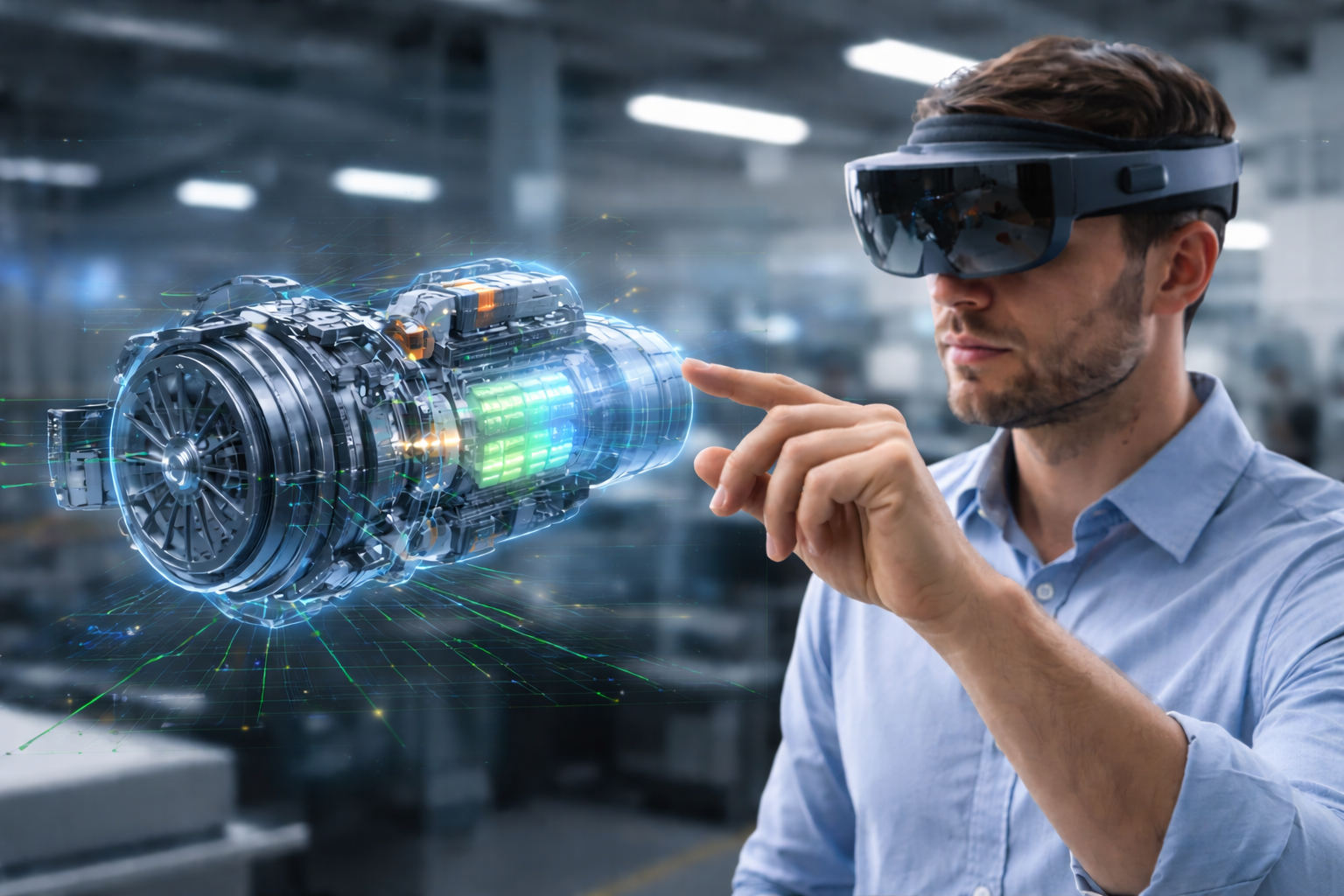
Transform design, collaboration, and workflows.
Engineering is evolving, and so is the way engineers interact with their designs. Spatial computing, a computing paradigm that integrates the physical and digital world, is at the forefront of this transformation. By leveraging augmented reality (AR), virtual reality (VR), and extended reality (XR), engineers can visualize, analyze, and collaborate on designs like never before.
What is spatial computing?
Spatial computing is a mode of computation that inherently uses space, both physical and virtual. Unlike traditional 2D interfaces, where interaction happens on a flat display, spatial computing adds a third dimension. The input and output of these systems depend on a user’s position in space, creating immersive experiences that respond to real-world perspectives.
This concept includes:
- Virtual Reality (VR): Fully synthetic environments that immerse the user in a virtual world.
- Augmented Reality (AR): Overlays digital information onto the physical world, responding dynamically to the user’s position.
- Augmented Virtuality (AV): Integrates elements of the real world into a virtual environment.
- Mixed/Extended Reality (MR/XR): Blends real and virtual environments for interactive experiences.
The reality-virtuality continuum, first defined by researchers Paul Milgram and Fumio Kishino, encompasses all these technologies, providing a framework for engineers to choose the right tool for the task.
How engineers are using spatial computing.
Spatial computing isn’t just a buzzword, it’s a practical tool for engineering innovation:
- Design Visualization: Engineers can view 3D models at scale in the real world. Automotive teams, for example, can walk around a full-size vehicle model using AR or VR headsets, seeing fine details and evaluating ergonomics without building costly physical prototypes.
- Collaboration: Teams across multiple locations can interact with the same virtual model simultaneously, accelerating design decisions.
- Factory Planning: AR and VR help plan layouts, optimize workflows, and visualize equipment placement before physical installation.
- Maintenance and Training: Overlaying instructions or simulations on real equipment enables faster, safer, and more effective worker training.
Your robust ecosystem.
Siemens Software provides a robust ecosystem for leveraging spatial computing in engineering workflows:
- NX and Solid Edge: Create accurate, photorealistic 3D models optimized for AR/VR experiences.
- Teamcenter X: Centralizes design and PLM data, ensuring all team members work with the latest models and specifications.
- Tecnomatix: Simulate human and robotic interactions in virtual environments for manufacturing and maintenance planning.
With cloud-based platforms, even smaller suppliers can access high-performance computing resources without large upfront costs, increasing competitiveness.
Why spatial computing matters for executives.
For executives, spatial computing isn’t just about flashy tech, it’s about strategic value:
- Accelerates product development timelines.
- Improves cross-functional collaboration.
- Reduces risk from errors in early design stages.
- Provides a competitive edge through immersive, data-driven decision-making.
Spatial computing is poised to reshape how engineers conceptualize, evaluate, and refine designs. By integrating AR, VR, and XR into workflows with Siemens Digital Industries Software, organizations can unlock a new dimension of innovation, accuracy, and speed.
Learn how spatial computing can transform your engineering workflow.