
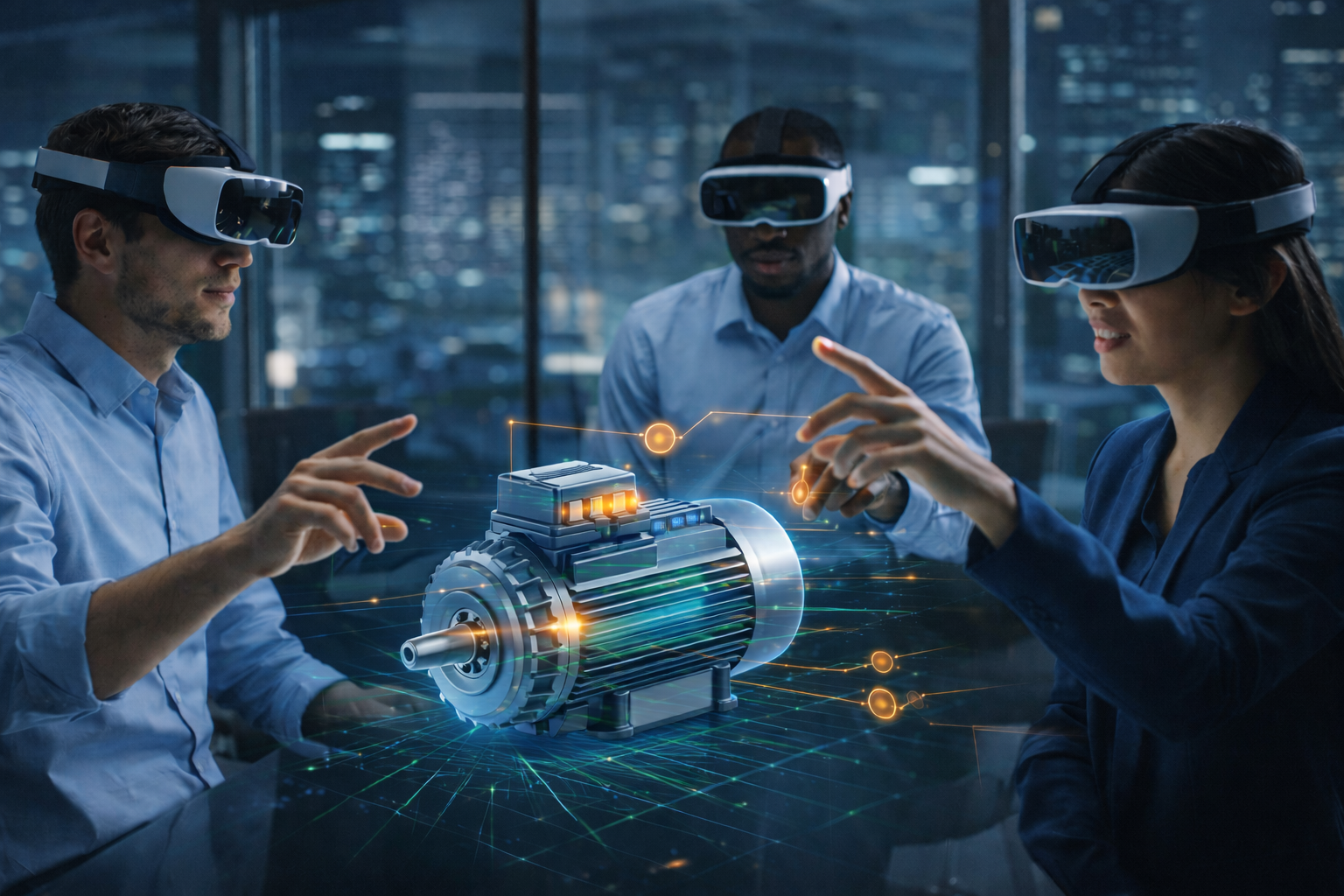
Driving measurable value with AR, VR, and XR
Spatial computing isn’t just theoretical, it’s delivering measurable results for engineering teams across industries. By combining augmented reality (AR), virtual reality (VR), and extended reality (XR) with Siemens Digital Industries Software, organizations can accelerate product development, reduce costs, and improve operational efficiency.
Real-world applications
- Design Validation and Virtual Prototyping
Engineers can overlay digital models onto physical prototypes or spaces, enabling rapid evaluation without expensive mock-ups. For example, a team designing a new heavy equipment component can use AR to identify assembly conflicts, ergonomic issues, or potential mechanical interferences before committing to production. - Factory Layout and Process Planning
AR and VR allow engineers to visualize workflows, machine placement, and human-robot interactions in a simulated environment. Siemens Tecnomatix Process Simulate (Human and Robot) lets teams optimize layouts and validate operations, avoiding costly redesigns or process bottlenecks. - Training and Maintenance
With spatial computing, training can happen on virtual equipment, reducing downtime and risk. AR headsets overlay step-by-step instructions directly onto machinery, improving technician efficiency and reducing errors. - Collaboration Across Teams and Locations
Using Teamcenter X, spatial computing assets and simulation data are shared securely across global teams. Design changes are propagated instantly, ensuring everyone works from a single source of truth. This reduces errors caused by outdated CAD versions or disconnected workflows.
Quantifying ROI
Integrating spatial computing into engineering workflows delivers tangible value:
- Design Cycle Reduction: Companies report up to 30% faster design validation through AR/VR reviews.
- Prototyping Cost Savings: Virtual prototyping can reduce physical prototype requirements by 40–50%.
- Error Mitigation: Early detection of design and assembly issues reduces downstream rework costs by 25–35%.
- Training Efficiency: AR-guided maintenance and assembly training can cut training time by 20–30% while improving accuracy.
For executives, these savings translate directly into improved margins, faster time-to-market, and a stronger competitive position.
Spatial computing success begins here
Siemens Software provides a robust ecosystem for leveraging spatial computing in engineering workflows:
- NX & Solid Edge: Deliver highly accurate 3D models for AR/VR visualization.
- Teamcenter X: Ensures all design data, CAD models, and simulations are synchronized and traceable.
- Tecnomatix Process Simulate (Human & Robot): Optimizes manufacturing and logistics workflows virtually before real-world implementation.
By integrating these tools, engineers can leverage the full potential of spatial computing while maintaining PLM consistency, ensuring regulatory compliance, and mitigating risk.
Strategic benefits for engineering leaders
For executives, spatial computing delivers more than operational efficiency:
- Enables faster, more informed decision-making with real-time, immersive design insights.
- Improves supplier and stakeholder collaboration through shared digital models.
- Reduces risk and cost associated with physical prototyping and delayed design validation.
- Supports innovation in complex systems, from aerospace to heavy equipment, by enabling multi-domain engineering analysis.
Future outlook
As AR, VR, and XR hardware improves, spatial computing will become increasingly essential. High-fidelity VR headsets and photorealistic AR visualizations will allow engineers to simulate entire workflows, evaluate multiple design alternatives, and make physics-based decisions with unprecedented confidence.
Siemens Digital Industries Software ensures that organizations are not just experimenting with spatial computing, they’re integrating it into a structured, ROI-driven engineering strategy.
Explore how spatial computing can transform your engineering workflow.