
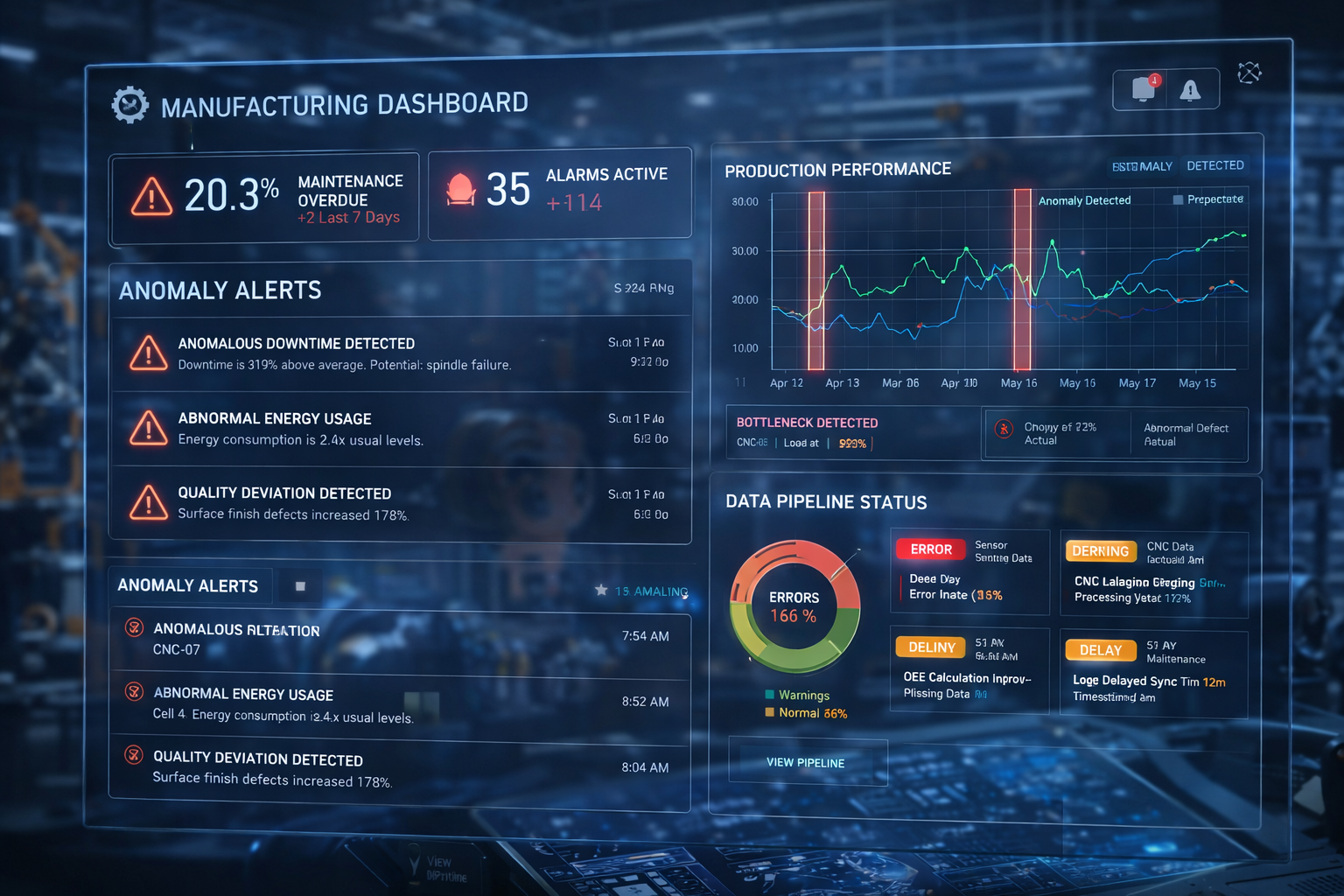
Here’s what’s actually going wrong (and how to fix it).
Implementing data pipelines sounds simple. Extract, transform, load, done. In reality, it’s one of the most failure-prone areas in modern manufacturing and enterprise data systems. When pipelines fail, everything downstream breaks with them: dashboards, analytics, AI models, and ultimately, decision-making.
The companies getting this right don’t treat pipelines as plumbing. They treat them as mission-critical production systems.
Pipelines fail long before production.
Most failures don’t happen at scale. They happen at the beginning. Data pipelines vary widely in complexity because the business problems they support are equally complex. The mistake? Treating them like generic infrastructure instead of business-critical systems.
Poorly defined requirements = guaranteed rework.
This is where most pipelines go off the rails. “Build a dashboard for defects” is not a requirement. It’s a vague request.
What actually matters:
- What defines a defect?
- Who is using the data?
- How often does it need to update?
- What decisions will this data drive?
Without that clarity, pipelines get rebuilt mid-project, driving cost and delays.
Business Impact:
- 20–40% increase in development time due to rework.
- Misaligned KPIs leading to poor decisions.
- Delayed time-to-value for analytics and AI.
Most manufacturers don’t have a modeling problem. They have a data fragmentation problem.
Data quality issues contaminate everything.
Bad data doesn’t just create bad dashboards. It destroys trust.
Common issues:
- Missing or duplicate records.
- Inconsistent formats.
- Corrupt or partial data.
If your pipeline doesn’t actively manage data quality, it becomes a distribution system for bad decisions.
What actually works:
- Built-in validation rules.
- Schema enforcement.
- Automated anomaly detection.
- Data quality monitoring metrics.
ROI impact:
- 15–30% reduction in scrap, rework, or reporting errors.
- Faster root cause analysis.
- Increased trust in analytics outputs.
Pipelines that don’t scale will break.
Everything works fine, until it doesn’t. Pipelines that run in minutes during testing suddenly take hours in production.
Why?
- Inefficient joins.
- Poor partitioning.
- Memory bottlenecks.
- Unoptimized ETL logic.
Fix it before it breaks.
- Use incremental processing, not full reloads.
- Design for parallelism.
- Separate compute for ingestion vs querying.
- Optimize infrastructure early.
ROI impact:
- 30–70% reduction in processing time.
- Lower cloud and infrastructure costs.
- Faster access to insights.
Orchestration complexity is where pipelines collapse.
Data pipelines are not single workflows. They’re chains of dependencies, and that’s where complexity explodes.
Typical issues:
- Job dependencies breaking.
- Failed retries causing cascading errors.
- Manual fixes for missing or bad data.
How to simplify:
- Use staging layers to break complexity into steps.
- Prioritize trusted data sources.
- Replace custom scripts with enterprise-grade platforms.
ROI impact:
- 25–50% reduction in pipeline failures.
- Faster recovery from errors.
- Reduced engineering overhead.
No monitoring = silent failures.
This is one of the most dangerous gaps. Pipelines don’t always fail loudly. They fail quietly.
Common issues:
- Missing data.
- Delayed updates.
- Incorrect outputs.
And no one notices until decisions go wrong.
What you need:
- Data freshness tracking.
- Volume anomaly detection.
- Schema change alerts.
- End-to-end pipeline timing.
ROI impact:
- Reduced downtime for analytics systems.
- Faster issue detection.
- Increased confidence in data-driven decisions.
Environment and deployment chaos.
Pipelines behave differently across different areas.
Including:
- Development.
- Testing.
- Production.
They do this due to:
- Configuration mismatches.
- Data inconsistencies.
- Infrastructure differences.
How should you fix this?
- Standardize environments.
- Automate deployments.
- Enforce version control discipline.
ROI impact:
- 20–40% reduction in deployment issues.
- Faster release cycles.
- Improved system reliability.
Pipelines that can’t evolve will eventually fail.
Business needs change, pipelines often don’t. It first starts as batch analytics.
Then it becomes:
- Near real-time dashboards.
- AI model inputs.
- Cross-functional data systems.
Rigid architectures can’t adapt without major rework.
The smarter approach begins with:
- Loosely built coupled systems.
- Scalable data platforms.
- A system designed for change from day one.
ROI impact:
- Lower long-term maintenance costs.
- Faster adaptation to new use cases.
- Extended system lifespan.
The executive ROI: what good data pipelines actually deliver.
When pipelines are designed correctly, the impact is measurable:
- 30–60% faster reporting and analytics.
- 20–40% faster decision-making.
- 15–30% reduction in operational inefficiencies.
- 2–5x acceleration in AI and digital transformation initiatives.
- Significant reduction in engineering rework and maintenance costs.
This isn’t about better data engineering. It’s about better business performance.
The bottom line.
Data pipelines are not just technical infrastructure. They are the foundation for:
- AI.
- Digital transformation.
- Operational intelligence.n
Treat them like an afterthought, and they will fail quietly. Treat them like a strategic asset, and they become a competitive advantage.