
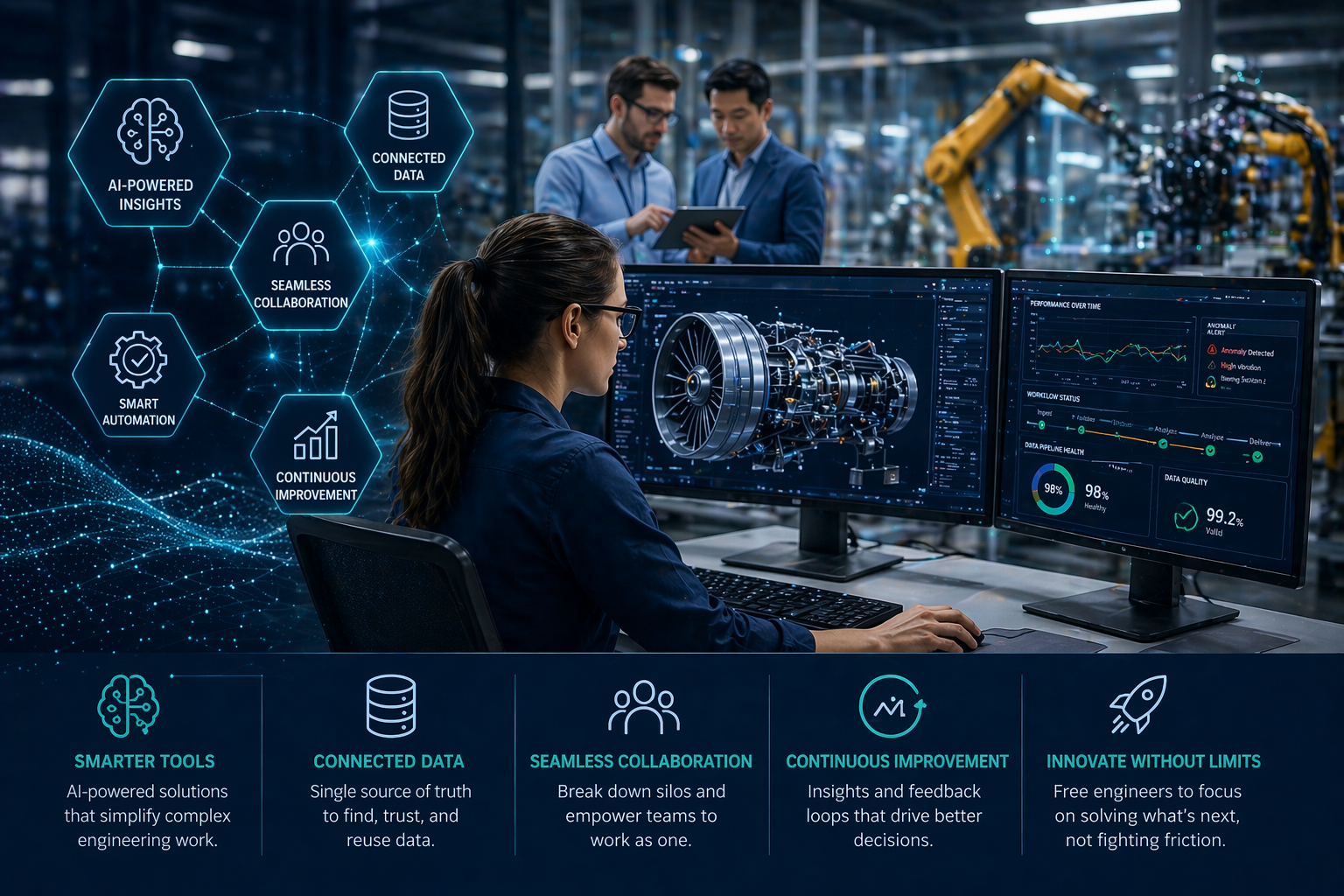
A day in the life: why does engineering feels harder than it should?
Picture an automotive engineer building a control unit for an EV. The engineering itself is complex, but manageable. The real friction comes from everything around it.
Data is scattered across PLM, ALM, simulation tools, spreadsheets, and supplier systems. A single change request triggers a cascade:
- BOM updates.
- Simulation reruns.
- Variant checks.
- Cross-team notifications.
Instead of engineering, teams spend time chasing data, reconciling versions, and waiting. That’s not innovation. That’s orchestration failure.
The real problem: orchestration, not engineering.
Most organizations didn’t plan to create fragmented environments, they evolved into them.
Over time:
- New tools were added.
- Processes became siloed.
- Data lost context.
Engineers became human integration layers. The result?
- Slower decisions.
- Higher risk.
- Over-engineering as a safety net.
The issue isn’t capability. It’s connection.
From fragmentation to flow: the digital thread in action.
A digital thread changes the game. Instead of manually stitching processes together:
- Data stays connected across systems.
- Context follows every change.
- Workflows trigger automatically.
When a requirement changes:
- Impacted components are identified.
- BOM baselines are updated.
- Simulations are aligned.
- Documentation is prepared.
Engineers don’t chase information, it comes to them.
Agentic workflows: practical AI for real engineering work.
Traditional automation follows rules. Agentic workflows go further:
- They understand context.
- They interpret relationships.
- They recommend next steps.
But let’s be clear, this isn’t autonomous engineering. The winning model today is human-in-the-loop AI:
- AI prepares and suggests.
- Engineers approve and decide.
That balance delivers speed without sacrificing control.
What AI fabric actually delivers.
Siemens AI Fabric acts as the foundation layer for scaling AI across engineering and manufacturing. It connects:
- Data.
- Workflows.
- Governance.
And it does it without forcing a rip-and-replace strategy. Organizations typically start small:
- One workflow.
- One use case.
- One measurable outcome.
Then scale from there. That’s how AI becomes operational, not experimental.
Turning dark data into engineering intelligence.
Most companies already have the data, they just can’t use it. Simulation outputs, test results, and quality data often sit unused. AI-powered workflows unlock it by adding context. Engineers can finally ask:
- What changed that caused defects?
- Which variants are failing tests?
- Which suppliers are driving issues?
This turns passive data into active decision-making fuel.
Brownfield meets greenfield: modernizing without disruption.
No one is ripping out decades of PLM, MES, or ERP systems. And they don’t need to. Modernization happens through:
- APIs.
- Workflow orchestration.
- Integration layers.
This allows companies to:
- Improve processes immediately.
- Reduce risk.
- Preserve existing investments.
Greenfield projects then adopt the same model from day one.
Collaboration at scale: why ecosystems win.
Engineering no longer happens inside four walls. Suppliers, partners, and internal teams all need access to the same context. When systems are connected:
- Changes propagate instantly.
- Errors are caught earlier.
- Decisions happen faster.
But this only works with strong governance:
- Controlled access.
- Auditability.
- IP protection.
Collaboration without control creates risk. Collaboration with structure creates advantage.
The ROI of intelligent engineering workflows.
Let’s cut to what matters, results. Organizations implementing digital thread + AI-driven workflows typically see:
Cycle Time Reduction:
- Engineering change cycles: 30–60% decrease.
- Decision latency: 40–70% decrease.
Productivity Gains:
- Manual coordination effort: 50%+ decrease.
- Rework from misalignment: 25–50% decrease.
Quality Improvements:
- Early error detection: increase significantly.
- Compliance readiness: faster and more consistent.
Cost Impact:
- Engineering cost per program: decreases 15–30%.
- Scrap and late-stage fixes: decreases substantially.
Time-to-Market:
- Program delivery acceleration: 20–40% faster.
And in targeted workflows (like BOM updates or simulation prep), teams report up to an 80% faster execution. That’s not incremental improvement. That’s structural advantage.
Stop managing complexity, start eliminating it.
Engineering isn’t getting simpler. But the way we manage it can. Digital threads, agentic workflows, and AI copilots don’t replace engineers, they remove the friction holding them back. The companies pulling ahead aren’t adding more tools. They’re connecting what they already have, and letting intelligence flow through it.
See how AI-powered engineering workflows can cut cycle times by up to 60%.